
I'm a Mom
The Things They Don’t Tell You—Until They Do

Trigger Warning: This essay touches on themes of Postpartum Anxiety, Postpartum Depression, death, and contains explicit language.
I feel nothing but pressure.
It’s not emotional pressure or psychological. Those come later. It is a physical pressure on my chest, like lying beneath a stampede of agitated elephants.
“I can’t breathe,” I whimper, because I truly feel like I can’t.
I’m told to calm down, that I’m okay, and that this is normal. It’s just my nerves; it will be over soon.
The fluorescent lights blind me as I lie there with my arms out, like Jesus on the cross. Although I can’t feel anything—logically, I know I can’t—I still get the sensation that my body is being torn open.
Because it is.
The tugging and pulling rock me side to side, but 60 seconds later, which feels like 60 hours, it’s done. A sound cuts through the sterile room, a raspy wail.
My daughter, my first child, is out.
A nurse in a blue OR apron and matching cap brings her around the curtain stretched across my midsection, in all her naked, fresh-out-of-the-oven glory.
My first glimpse of her is brief, just two seconds, before she is whisked away.
I start crying.
I’m not allowed to hold her yet, and the disappointment becomes another crushing force.
This time, on my heart.
I’m supposed to do skin-to-skin immediately. Everybody says so. The urge to tell them is there, but I don’t. There is too much going on, too many moving parts I can’t keep track of in my delirium.
The nurse carries her to a station on my left, which is a cross between a bed and a changing table. Another nurse, a man, begins rubbing her roughly with a towel.
Jesus, take it easy!
I don’t tell him how to do his job, but inside I am screaming profanities at him.
Next, he works to clear her lungs, and panic washes over me. Her cries come out uneven and gurgled, like she is choking on water. I hear the suction bulb before I see it, before I understand what is happening.
Suck—slurp—slosh.
Suck—slurp—slosh.
Over and over.
“What’s going on? Why is he doing that to her? Can she breathe? Is this normal?”
My best friend—a nurse at the hospital, but only there to support me that day—barely has time to answer one question before another one flies out of me.
What I am feeling is new, this panic. It consumes me. I feel it in my chest, the only place that isn’t numb. Her ability to breathe is all I can think about, and the fear feels physical.
Oh my God, what if she dies on that table right in front of me?
I haven’t even held her yet.
My baby is less than three minutes old, and I am already imagining it—
Her death.
My husband, Tony, is standing by the table now with his hands clasped behind his back, grinning ear to ear, trying but failing to contain his excitement. He tells me they are weighing her. “She’s seven pounds, fifteen ounces. Nineteen inches long,” he calls over his shoulder, eyes filled with elation.
Our Mila Renee.
I am still on the operating table. The doctors need to finish stitching me up. Tony returns to the stool at my side, and a nurse finally brings Mila over. She puts her right up to my face.
She has stopped crying. A blue-and-pink striped beanie covers her head. Her body is wrapped in a white hospital blanket patterned with pastel animals. Her skin, a bright pink, no longer the angry shade of red from before. I am allowed to kiss her cheek, smaller than the palm of my hand.
“Hello, Mila. I’m your mommy. I love you so much.”
It feels like the right thing to say, the thing I am supposed to say in this moment. I know it’s important that she hears my voice, the one that spoke and sang to her every day for nearly nine months, but my mind is already somewhere else, circling back to one thought—
Is she breathing?
I tell Tony to make sure the blanket doesn’t cover her mouth when he holds her. He’ll get to in the recovery room before I get there.
“She’s fine, Dev. She’ll be okay.”
I wish I could believe him. I wish I could emulate the ease he expresses effortlessly.
I really wish my mind would shut the fuck up.
When I am cleared to leave the OR, they wheel me into recovery, where I am finally allowed to hold her.
“I’m supposed to do skin-to-skin with her. Can I do that now?”
The urgency in my voice makes it sound like if it doesn’t happen immediately, something irreversible will follow. The nurse pulls my gown down, unwraps Mila, and places her on my chest. I stare into her blinking eyes, in awe, hardly believing she’s actually here.
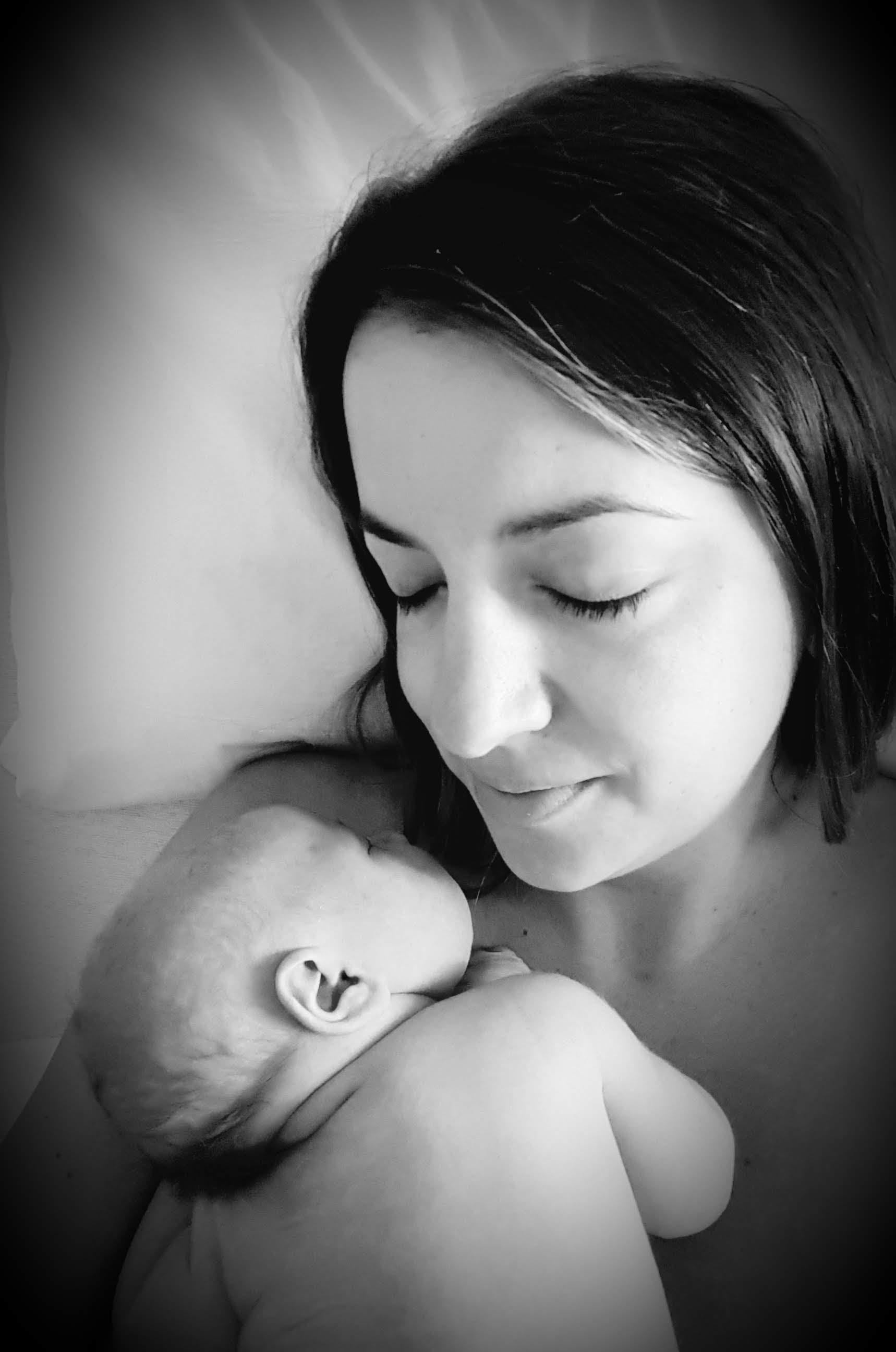
That I’m a mom.
“We should see if she can latch,” the nurse suggests, as she takes my exposed breast and guides Mila’s mouth to it.
How is she supposed to breathe with her face pressed into me like that?
She latches with ease, and for a few minutes it is just us, our bodies, our souls connecting the way nature intended.
When she loses interest and closes her eyes, the nurse lifts her from me, wraps her again, and places her back in my arms. I keep my eyes fixed on the blanket, which feels too close to her mouth.
Is she swaddled too tight?
Visitors who’ve been waiting in the lobby are allowed into the recovery room one at a time. Everyone wants a turn holding her. I watch them all with sharp, unblinking focus. I even watch Tony, who has done this before—seven years prior with my stepson.
No one is safe from my gaze.
We are eventually released from recovery and wheeled into the room that will be ours for the next two to three nights. I get to hold Mila as we go. A lullaby plays over the loudspeaker, wordless, just soft chimes.
“That’s her song,” my friend says, filming our walk down the hospital corridor.
“Hush, little baby, don’t say a word. Mama’s gonna buy you a mockingbird.”
I smile and softly sing the lyrics to Mila.
My legs are still numb, and I’m concerned that it has been too long. The nurses assure that it hasn’t been, that they will remain numb for a few more hours.
Once I am transferred into my new hospital bed, I am allowed to sit up a little straighter. The pain from my abdomen as I strain to adjust myself, radiates up my body, like I’m being torn open again.
Holy shit….
I insist on more skin-to-skin time with Mila, but a nurse walks in and tells Tony to take her, that there is something she needs to do to me, and I’ll have to lie back down.
“You have to take your shirt off and do skin-to-skin, Tony. It’s just as important as mine. She needs to know her daddy’s smell.”
My tone is urgent again, all business. Tony takes it in stride.
The nurse lowers my bed while explaining what she’s about to do.
I brace myself.
She begins kneading my uterus like a ball of dough to push anything excess out. Nausea hits instantly with her first deep press. I’ve never felt anything so excruciating. It is torturous. The sensation feels completely wrong.
What in the hell have I done…
I spend my afternoon motionless in that bed. I remind every nurse who comes in that my legs are still numb, that something must be wrong. After each reassurance, I try to settle and be content to lie there while visitor after visitor comes in to meet Mila and congratulate us.
They all hold her, and while they do, they are given the same request—
“Make sure she’s still breathing, please.”
Some of them laugh it off. Some think nothing of it, assuming it is a natural new-mother worry.
One person doesn’t. My other best friend can hear it in my voice, can see it in my expression—
Anxiety tightening its grip.
“Dev, you need to stop. Relax. She’s okay.”
But it feels impossible.
That first night in the hospital is rough. Babies need to eat, be held, snuggled, kept warm.
Loved.
I’m convinced she wants to drive me crazy.
Tony and I argue over whose turn it is to hold her, rock her, or swaddle her. We are exhausted after being up since 3:00 a.m.
No one told me how sore I’d be, how my midsection would burn, how much it would hurt to hold Mila against my incision when I breastfeed. I clench my teeth through the pain and continue to refuse the pain killers.
I’m afraid of becoming addicted.
Mila will not settle, especially when we lay her down in the hospital bassinet.
I break again. “What’s wrong with her? What am I doing wrong?”
Tony’s exhaustion and growing impatience isn’t helpful.
I grow resentful of him when he falls asleep in the chair-turned-bed beside me. I’m not afforded the luxury of sleep.
I have to breastfeed our baby.
He has always been a sound sleeper; the second his head hits the pillow, he’s out. Right now, it feels like betrayal.
When I snap at him to help me, he snaps back.
Nurses come and go. They swaddle Mila for us because neither of us can do it to her satisfaction.
I still have not gotten out of bed.
The cycle repeats through the night: nurse checks, feedings, fussing, pumping or hand expression for a single drop of colostrum—liquid gold they call it—and holding her so she will sleep.
Which means I do not.
At one point, a nurse gently suggests that we might want to use the nursery to catch up on sleep. She must see the frantic fatigue in my eyes. She means well, and she is kind with her delivery, but her suggestion enrages me.
Give my baby to the nursery? Like I’m a terrible mother? Does she think I can’t handle my baby?
Over my dead body.
I decline the offer incredulously.
My exhaustion, stubbornness, and fear begin to twist into something else. I feel it immediately, something I don’t quite recognize—or don’t want to.
And it feels directed towards Mila.
When my nurse friend visits again, she is shocked to learn that I have not walked further than the few steps it takes to get to the bathroom. I tell her why—that when I finally did get up, hobbling forward inch by inch, hands pressed firmly to my abdomen, I had to grip the handlebar near the toilet with both hands to lower myself, with the nurse’s hands steadying me under my shoulders.
“Get up,” she demands. “We’re walking down the hall. You need to move, Dev. Your recovery will be harder if you don’t.”
Great. Now someone tells me.
Getting out of bed is difficult, and swinging my legs over the side requires core strength I don’t have. Standing is worse. Shuffling into the hall—agonizing.
How am I supposed to carry my baby if I can’t even walk without bracing myself?
Again, I wonder—
What in the hell have I done?
The pain feeds that sharp, unfamiliar feeling.
It’s growing.
I keep smiling and greeting visitors, acting the way I’m expected to act. I remind myself that some women never get to experience this, and that I should be grateful, that this is what I’ve always wanted.
I chastise myself for my selfishness, adding it to the list of everything I am doing wrong.
When it’s time to be discharged, I cry. I cannot believe they are sending me home with her, that they’re trusting me to take care of her.
What if she’s too small for the car seat? What if I don’t strap her in properly? What if we get in an accident? Her going-home outfit shows too much skin—what if she gets cold?
As we dress our baby to leave, we notice tiny red dots scattered across her skin.
“Does she have a rash? Is she allergic to something? Do they hurt her?”
The nurse just smiles, calm and certain. “No, Mama. She’s fine. They’re called stork bites. They’ll go away on their own.”
Tony carries Mila in the car seat while I’m wheeled down the hall, into the elevator, and out to the covered drive where our car waits. I tell him at least fifty times to be careful, to stop swinging her, to be gentle when he sets the seat down.
The drive home is slow. Quiet—except for me telling Tony to be more cautious, to watch the road, to pay attention to the cars. Mila starts crying, and my heart rate spikes. My stomach twists in knots. Only now we’re in the car, and there’s nothing I can do.
“Will you please hurry? She’s crying!”
As if he doesn’t know.
When we arrive home, I wince with every step as I slowly walk to the front door. Inside, my family has decorated the house with streamers, balloons, and a handmade Welcome Home Mila and Mom sign.
Great. Something I’ll need to clean later.
But I tell them how much I love it; how much it means to me.
Mila, still in her car seat, is set on the floor in the living room so our dog, Buck, can meet her. He’s the best dog, a black lab mix with a wise, old soul. We’ve been looking forward to introducing them. My family brought one of Mila’s hospital hats with them to prepare him with her scent.
He approaches slowly, like he knows he’s supposed to. He sniffs around her tiny body.
“Buck, no! Get back! Watch him!” I snap.
Everyone gives me the same perplexed look.
“He’s fine, Dev. He’s being so gentle. He’s just checking her out.”
But in my mind, it’s already happened: he gets too close, too comfortable. He lays right on top of her…
And suffocates her.
“Please move him. It’s making me nervous.”
They sigh, but they listen.
I take advantage of the help and go back to my bedroom to sleep. It’s fitful. Unfulfilling. My mind won’t shut off. I can’t stop thinking about Mila being away from me, when I’m the one who insisted on it.
After a couple of hours, someone wakes me to feed her. She’s hungry.
Again.
The rest of the day, I try to find joy, to make space for it, moments to just stare at her. Her eyes—maybe they’re going to be blue. Her nose—those little nostrils flare like her dads. Her full lips—women are going to envy those. Her body fits perfectly along my forearms, her head cradled in my palms. She is perfect.
Truly perfect.
By bedtime, those warm, fuzzy feelings are gone.
That first night at home is brutal. I don’t want Tony to sleep if I can’t. It doesn’t feel fair. And I cannot sleep.
My eyes feel heavy, but I won’t let them close. If I close them, she could stop breathing. I might miss it. If I don’t watch her—
She could die.
Every time I bring her to my breast, she falls asleep after only a few suckles. The nurses told me not to let that happen, to tickle the bottoms of her feet or stroke her cheek.
Neither work.
I want to put her down. I want to let her sleep so that I can, but I don’t know where to place her. She sleeps best in my arms. At my breast. The moment I lay her in the bassinet, she wakes.
It’s not safe to let her sleep next to me. Her dad is a reckless sleeper. We both worry he’ll roll over and smother her.
Is this going to be my life? Is this what parenting is supposed to feel like?
What the fuck have I done…
At her first doctor’s appointment, we’re told she’s lost too much weight. I meet with a breastfeeding consultant, who re-teaches me the different holds and ways to keep Mila awake during feedings.
She reiterates how important my breastmilk is.
I’m put on a seven-day feeding schedule: Feed at one breast for 20–25 minutes—she has to be actively sucking—then switch to the other for the same amount of time. Follow that by pumping for 20–30 minutes. Repeat every two hours.
“Come back in a week and we’ll check her progress,” she says to me with a smile that makes me want to punch her in her optimistic face.
What she neglects to say—
Welcome to seven days of hell.
That night I learn that there is no such thing as a solid twenty minutes of eating. Not for us. I’m wiping a cold washcloth down her cheek and across the bottoms of her feet. I strip her down to her diaper because being colder is supposed to keep her alert. It doesn’t.
It just pisses her off.
I get up and change her diaper because that’s supposed to wake her up. It does. And it makes her cry.
Loudly.
By the time I get through one side, it’s been 35 minutes.
Great, now I’m off schedule.
I can’t do anything right.
I start over on the other side.
When she’s finally done—another 35 minutes gone by—she has to be soothed back to sleep. Not in my arms, though. I still have more work to do.
I still have to pump.
I place her in the bassinet beside me and attach the pump to my breasts, plugged into the wall by the rocking chair I sit in. I rest my head in my left hand, elbow on the armrest, yawning incessantly. With the other hand I gently jiggle the bassinet, praying the motion and the hum of my breast pump will lull her to sleep.
It does.
For about 10 minutes.
By the time I store the half ounce of my milk—maybe one ounce, total—in the fridge, Mila is fussy again. Gassy. She needs to be held, burped, rocked. After what feels like a lifetime, I get her back to sleep. I lay her down in the bassinet slowly, gently, terrified of waking her. She stays asleep.
I release a sigh of relief. I did it.
As I finally lay down in my bed, so consumed with exhaustion I feel nauseous, I look at the clock.
It’s time to start over.
No one told me this part—that I’d have to push through sleepless nights, literally sleepless, for too many days in a row.
That my baby wouldn’t like the football hold, that she would only be able to latch sprawled across my aching torso.
Or that my nipples would crack and bleed.
No one mentioned that when you’re a Type 1 diabetic, your milk can take longer to come in. That you’ll think your baby is feeding because she latches well, but she isn’t getting enough.
That she’ll lose weight. Cry more.
That you’ll cry more, too.
What they don’t tell you is that you’ll sob in the shower, head resting against the wall, staying in as long as possible just for a break.
To bargain with God.
Help me. Please.
Save me.
That every wrong move—no matter how small, how insignificant—will riddle you with guilt.
That you’ll constantly put yourself down.
That you’ll hide the turbulence in your mind behind smiles for pictures. Because the pressure to make everyone believe you’ve got your shit together—that you love your new role—will matter more than the truth…
You can’t stand your baby.
No one tells you how you’ll feel when your doctor prescribes medication for your mental state, or how quickly shame takes over.
How it leads you to the toilet to flush them all away.
That doctors will give what you’re going through names—titles people cringe at when spoken aloud.
Ones you’ll be too embarrassed to let anyone know about.
No one tells you you’ll hate your husband. How you’ll micromanage him, snap at him, and berate him for doing everything wrong.
How you’ll cry the moment he leaves the house.
Leaving you alone with the baby.
While there are many things no one tells you, eventually, if you’re able to listen, they’ll tell you this—
You’re not crazy. What you’re experiencing is beyond your control. It’s not your fault. It’s not shameful.
You’re not a bad wife. You’re not a bad friend.
You’re not a bad mom.
That you can take your baby outside. You can walk together, soaking in the warmth and vitamin D the sun offers.
You can sing to your baby, and she will love your voice. She’ll look into your eyes while you sing lullabies, made-up songs, anything at all.
That those interlocking stares between you are powerful enough to heal.
They’ll tell you to stop breastfeeding, that your baby will survive without it.
That the blood and mucus filled diapers, the gas, the elimination diets layered on top of an already limited diabetic diet, aren’t worth the toll it’s taking on you.
That formula is just fine. That your baby will start thriving on it.
That the joy you’ll experience watching her finally gain weight will lift something in you you thought was gone.
They’ll tell you to join postpartum anxiety and postpartum depression groups, and that you’re not a failure if you do.
That you’re strong as hell for doing whatever it takes to heal, to find meaning in your new purpose.
How those groups of other moms will sit in it with you—the ugly muck—in solidarity.
That you’re not alone.
They’ll tell you that with time and the right tools, it can get better. That it looks and feels different for the mothers who walk this hard road. That it’s never too late to start over.
To try again.
That something will begin to break through, even when you don’t believe it ever will—
A light that will guide you to love.
Who won’t remember your struggles.
Who doesn’t expect perfection.
Who will gaze at you like you’re their world.
Your baby.
My light. My Mila Renee.
My heart aches for you during that time. I can imagine, that your past trauma clouded your first moments with Mila. I am so relieved that healing has brought you to writing. Beautiful recant of raw emotion. You are undoubtably a gift to many. Your journey is a comfort and healing force for many. ❤️
The most real description of the shock of motherhood I’ve ever read. Beautifully written, Devin, beautifully recalled. You are a master of identifying your emotional experiences in very relatable descriptiveness. Thank you.